One of these vendors publishes enough to compute a three-year bill by headcount. The other does not. That asymmetry is the finding.
What each vendor makes computable
Jobber publishes tier prices, included user counts and a flat USD 29 additional-user rate. Given a headcount you can compute a subscription cost for any size in this band, before contacting anyone.
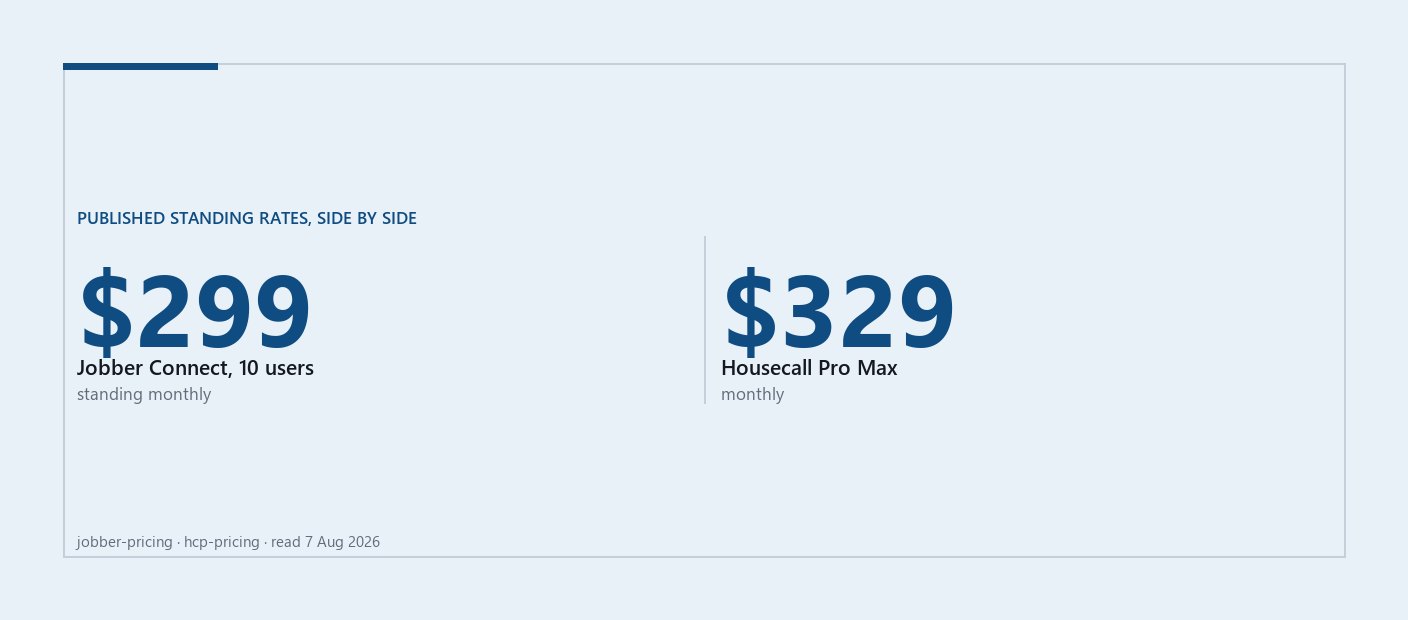
Housecall Pro publishes tier prices — USD 79, USD 189, USD 329 monthly; USD 59, USD 149, USD 299 annually — and does not publish included seats or additional-user cost. Given a headcount you cannot compute anything beyond the tier price itself.
So a genuine head-to-head three-year cost comparison by headcount is not possible from published information. It is possible on tier price alone, which is a different and much weaker comparison. Every page that presents a full multi-year Jobber-versus-Housecall-Pro cost table is either using unpublished figures or quietly assuming the seat question away.
The comparison that is actually supported
Subscription only, entry price only, 36 months, annual billing, ignoring seats entirely — and at the standing rate, not the introductory one:
Jobber Core at USD 29 monthly annually billed: USD 1,044 over 36 months, one user included. Jobber Connect from USD 99: from USD 3,564. Jobber Grow from USD 149: from USD 5,364. Jobber Plus from USD 439: from USD 15,804, five users included.
Housecall Pro Basic at USD 59 annually: USD 2,124 over 36 months. Essentials at USD 149: USD 5,364. Max at USD 299: USD 10,764.
The Jobber annual figures are the “then” prices. The introductory annual rates — USD 24, USD 80, USD 120, USD 352 — run for twelve months and were conditioned on a dated offer for new customers whose stated deadline, August 12 at 11:59 p.m. PT, had passed by 13 August 2026. A shop that subscribed in time paid twelve months at the introductory rate and twenty-four at the standing rate; a shop arriving now pays the standing rate throughout, which is why every total above is a standing-rate total. The vendor still shows the offer and has not said it ended, so treat the introductory column as unavailable rather than as abolished — and if you are quoted it, get the renewal rate and the end date in writing. Housecall Pro publishes no introductory period and no renewal step, so its annual figures are the same in month one and month thirty-six.
These are entry prices multiplied by 36. They are not your bill. Your bill includes seats — computable for Jobber up to fifteen users, unpublished for Housecall Pro — and processing, which for most shops is the larger number.
Where the seats take it
A 12-technician shop with 3 office seats is 15 users, and Jobber publishes a price for exactly that: Connect at fifteen users is USD 299 a month on annual billing at the standing rate, USD 10,764 over 36 months. That is the number to use. Had the introductory offer still been open, the first twelve months would have been at USD 240 and the total USD 10,056 — but its stated deadline of August 12 at 11:59 p.m. PT had passed by 13 August 2026, so USD 10,056 is shown to be recognised, not relied on.
It is worth saying plainly why that figure is not arrived at by adding seats. Fourteen additional users at the published USD 29, on top of Grow’s one-user price, computes to USD 505 a month — but Jobber publishes a fifteen-user price for the same tier on the same billing basis, and it is USD 299. Extrapolating from the seat rate when the vendor has already published the answer produces a number 69% too high. The rule this site keeps is that a price comes from the vendor’s page; that has to include the prices that are inconvenient to look up.
The equivalent Housecall Pro figure cannot be produced from published information. Not “is approximately”. Cannot be produced. If you need it, you have to ask them, and you should — then hold the answer against the arithmetic above.
And one more shop cannot be priced at all: add five more technicians and you are at twenty users, where Jobber’s published grid stops and the page directs you to sales. This site is written for shops running five to thirty technicians. For the upper half of that range, the vendor that publishes the most still does not publish enough.
The honest summary
On published information, Jobber can be priced by headcount and Housecall Pro cannot. That is a fact about disclosure, not about product quality, and it should not be read as a recommendation.
It does mean that if predictable, computable cost scaling matters to you, one vendor has already demonstrated it and the other has not.
Sources
- Jobber — primary vendor pricing page, read
- Housecall Pro — primary vendor pricing page, read
Vendor pricing changes without notice. Every figure above carries the date it was read. If a vendor’s current page disagrees with this one, the vendor’s page is right and this one is stale — and that is a bug worth reporting.