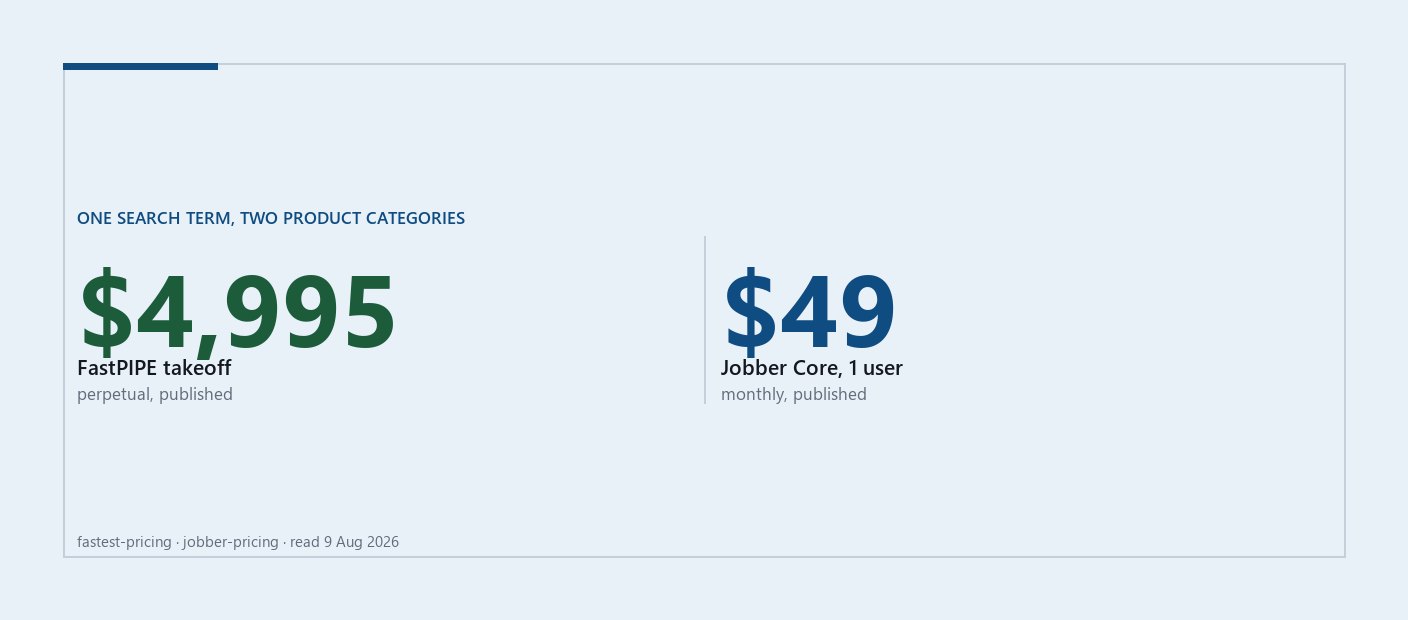
Search for plumbing estimating software and you get results whose published prices differ by a factor of a hundred. That is not a discount to hunt for. It is two product categories doing two different jobs, sitting on one results page.
The short answer
Two unrelated product categories are sold under the phrase “plumbing estimating software”, and the one you need is decided by where your price comes from before a technician arrives.
If your prices come out of a flat-rate book and a job is quoted, done and invoiced in one visit, the estimating you need is a feature of a field service platform. You are not buying estimating software; you are buying dispatch, scheduling and invoicing with quoting attached.
If your prices come out of drawings — counting fixtures, fittings and pipe runs off a plan set, applying labour units, assembling a bid against a deadline — you need a takeoff estimator. That is a separate industry with separate vendors, separate pricing conventions and, quite often, a perpetual licence rather than a subscription.
Truck Roll’s central claim is that service-call shops and installation contractors are different buyers who get handed one shortlist. Plumbing estimating is where that claim stops being an abstraction and starts costing money — the two categories are priced two orders of magnitude apart. The full argument is in service-call shop or installation contractor.
Why one search term returns two industries
“Estimating” means something different on each side of the split, and neither side thinks it is being ambiguous.
On the service side an estimate is a selection. The price already exists in a book; the technician picks the right line, possibly adds options, and presents it. The software problem is speed and consistency at the door — the same repair should not cost two different amounts depending on who is holding the tablet.
On the construction side an estimate is a construction in the literal sense. Nothing exists until quantities are counted off the drawings, priced against current material costs and multiplied by labour units. The software problem is measurement accuracy and bid assembly, and the risk being managed is that a missed quantity is absorbed at your own expense for the life of the contract.
A vendor competing for the same searches states the segmentation plainly: “most HVAC field service software reviews lump together two very different kinds of businesses: service-call shops that dispatch technicians for same-day repairs, and installation contractors who run D2D sales teams, build proposals on-site, and manage multi-week replacement projects — the right platform for each is completely different.” It says so, and then publishes a single ranked list anyway.
That is the whole defect. Both categories are legitimate software. Neither is a cheaper version of the other.
What each category costs, where a vendor publishes a price
Every figure below was read from the vendor’s own pricing page on the date shown in the sources. Where a vendor publishes nothing, the row says so and carries no number — not a range, not an estimate, not a figure from a comparison page.
| Product | Category | Published price | Basis |
|---|---|---|---|
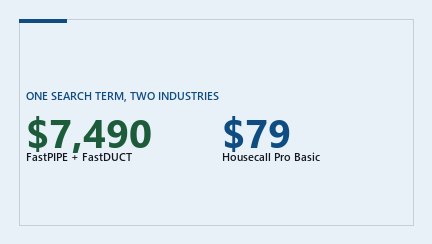
| FastEST (FastPIPE) | Takeoff estimating | $4,995 first application; $2,495 each additional; $7,490 for the FastPIPE and FastDUCT combination | Perpetual purchase. Optional maintenance $1,250 a year after the first year |
| FastEST (FastPIPE), lease | Takeoff estimating | $250 a month first application; $105 each additional; $355 for the combination | 36-month lease, ownership at the end |
| Knowify Core | Job costing and bidding | $99 and $149 a month | One user. The page shows both figures behind a Yearly/Monthly toggle and labels neither |
| Knowify Advanced | Job costing and bidding | $329 and $399 a month | Ten users. Same unlabelled toggle. Adds calculated cost templates |
| Jobber Core | Field service platform | $49 a month at one user; additional users $29 a month each | Monthly, no commitment. Prices published up to 15 users |
| Housecall Pro Basic | Field service platform | $59 a month billed annually; $79 billed monthly | The number of users included is not published |
| FieldPulse | Field service platform | Not published | Every tier asks you to request pricing. Seat-based, quoted per conversation |
| ServiceTitan | Field service platform | Not published | Three named tiers, full feature lists, no figure anywhere |
Rows reading not published carry no number on purpose. A price that reaches you only through a third-party comparison page is unverified, and this site does not print unverified prices — a secondary source reporting on one of the vendors above got two of three tiers wrong by quoting annual rates as monthly.
The gap is the finding. A takeoff estimator at $4,995 outright, or $250 a month on a 36-month lease that comes to $9,000, sits on the same results page as a field service platform at $49 a month. Read as competing quotes for one job, one of them looks like theft. Read correctly, they are quotes for two different jobs.
Deciding which one your work needs
Five questions decide it. They are about your work, not about features, and none of them requires a demo call.
- Where does the price come from? A book you maintain, or a drawing you measure. This is the single strongest signal and it is usually enough on its own.
- How long is the job? One visit, or weeks with progress billing. A platform that assumes the invoice follows the visit will fight you on the second.
- Who produces the number? The technician at the door, or an estimator at a desk who never goes to site. Software written for the first assumes a phone; software written for the second assumes two monitors.
- Do you bid against other contractors on the same drawings? If yes, speed and completeness of takeoff is the whole competitive position, and no field service platform is competing for that job.
- Do you take deposits and bill in stages? Progress billing and retainage are construction-accounting features. Their absence is not an oversight in a service platform; they are simply not part of the work it models.
Answer four or five one way and the category is decided. Split answers are common and they are not a failure of the questionnaire — they mean you run both kinds of work, which is the case the next section covers. The estimating fit finder walks the same five questions and shows which answers drove the result, so you can disagree with the reasoning rather than just the verdict.
On the service side, the estimating capability is a feature of a larger platform and should be assessed as one. What that looks like in practice is in quoting and estimating on site, and the workflow requirements specific to plumbing shops are in plumbing contractor workflow requirements.
The shops that genuinely need both
A plumbing business running service trucks and taking on bathroom remodels or new-construction rough-ins is not an edge case. It is ordinary, and it is the hardest buying position in this market.
The failure mode is buying one product and forcing the other job through it. Running a construction bid through a flat-rate quoting screen means rebuilding the takeoff by hand in a spreadsheet and pasting a total in, which loses the audit trail that made the estimate defensible. Running service calls through a construction estimator means an estimator-priced job for a $200 drain clear.
The honest structure for that business is two systems with a defined handoff: the estimator owns the bid until it is won, the field service platform owns the job from award through invoice, and exactly one of them owns the customer record. Which one is a decision worth making deliberately, because it decides where your history lives.
What this comparison cannot tell you
Four limits, stated so they are not discovered later.
- Two of the four field service platforms named here publish no price at all. FieldPulse asks every tier to request pricing; ServiceTitan names three tiers and publishes no figure against any of them. Their absence from the price table is a fact about the market, not a gap in the research.
- Knowify’s two figures per plan are unassigned. The page shows $99 and $149 for Core behind a Yearly/Monthly toggle without labelling which figure belongs to which basis. The lower one is very probably the annual-prepaid rate, because that is the near-universal convention — but “very probably” is an inference and this site does not print inferred prices.
- No takeoff accuracy claim is made here. How well any estimator counts fittings off a real plan set is a question about software behaviour, and answering it would require operating the software.
- Prices move. Every figure carries the date it was read. One of the vendors in this ledger ran a dated promotion whose stated deadline — August 12 at 11:59 p.m. PT — passed days after this page was written, and it was re-checked at source on 13 August 2026. A promotional rate is not a price you can plan against, which is exactly why none of the figures on this page is one.
What this page can tell you is which of two categories your work belongs to, and what each category publishes when you ask it for a price. That is a smaller claim than most pages on this search make, and it is one that can be checked.
Questions people actually ask
Sources
- FastEST, Inc. — primary vendor pricing page, read
- Knowify — primary vendor pricing page, read
- FieldPulse — quote gated confirmed, read
- Jobber — primary vendor pricing page, read
- Housecall Pro — primary vendor pricing page, read
- ServiceTitan — quote gated confirmed, read
- Workyard — secondary unverified, read
Vendor pricing changes without notice. Every figure above carries the date it was read. If a vendor’s current page disagrees with this one, the vendor’s page is right and this one is stale — and that is a bug worth reporting.