Somewhere between ten and thirty technicians the market stops publishing prices and starts asking for your phone number. Here is where that line falls and how to cross it without losing your footing.
The band where the market changes shape
Below about ten technicians the SMB platforms publish what they charge and you can compute your bill from a web page. Above about twenty-five, the platforms aimed at you do not publish anything and the first real number arrives after a demo call.
Ten to thirty is the crossing. It is also where most of the money is, which is why it is the most heavily marketed and least clearly priced part of this market.
What is still published at this size
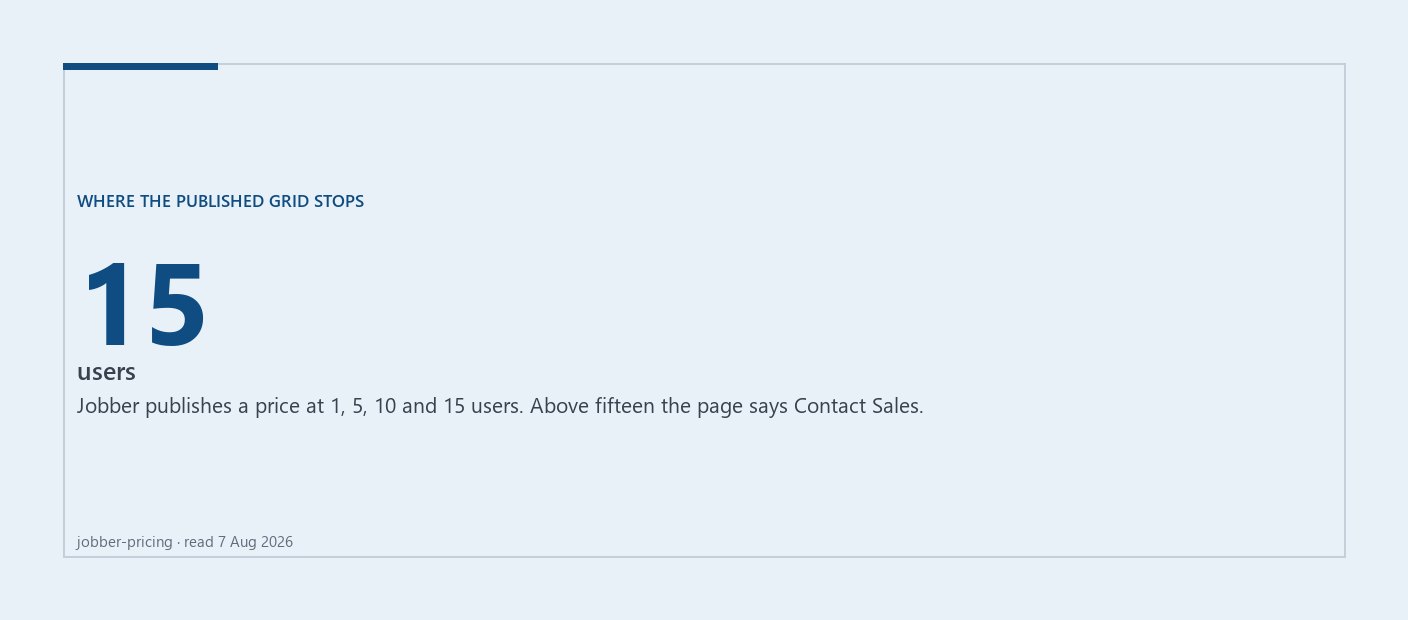
Jobber’s published grid still scales, up to a point: Grow is quoted at one, five, ten and fifteen users, from USD 199 to USD 499 monthly with no commitment, or from USD 149 to USD 399 billed annually at the standing rate. Plus is quoted at five, ten and fifteen users, USD 499 to USD 699 monthly, or USD 439 to USD 529 annually. Additional users remain USD 29 per month.
Those annual figures are the standing rates. The rates Jobber advertises — from USD 120 on Grow, from USD 352 on Plus — run for twelve months and are conditioned on a dated offer for new customers, so they are what you pay in year one and not what you pay in year three.
And this is where the page stops. A twenty-technician shop with four office seats is twenty-four users, and Jobber publishes no price at twenty-four users: above fifteen it directs you to sales. You cannot do that arithmetic before speaking to anybody, and multiplying the USD 29 additional-user rate out to twenty-four seats is not the published answer — Jobber’s own fifteen-user price is already lower than that extrapolation gives at fifteen.
Housecall Pro’s Max tier is USD 329 monthly or USD 299 annually. What it includes in seats is not published, so a twenty-four-user total cannot be priced from that page either.
So at twenty-four users every platform in this comparison is quote-gated for you. That is the honest finding for the top half of this bracket, and it is worth knowing before you spend an afternoon building a spreadsheet that cannot be filled in.
What is not published, and what to do about it
ServiceTitan is the platform most often recommended at this size and it is confirmed quote-gated. Its pricing page states the model — “per-technician pricing” — and adds that “each business has unique goals and we help find the best-value plan”. Then it asks for your industry, your technician count, whether you have office staff, and your business focus.
Third-party sites circulate figures for ServiceTitan: around USD 5,000 a year rising past USD 20,000, small teams at USD 500 to USD 800 per seat monthly, onboarding at USD 5,000 to USD 20,000. We do not use these numbers and neither should you. They are not from the vendor. In the course of building this site we caught a widely-repeated secondary misreporting Housecall Pro’s own published tiers — quoting annual rates as monthly and getting two of three tiers wrong by USD 20 and USD 100. A secondary that cannot copy a published number correctly is not a source for an unpublished one.
What to do instead: go into the call with your own numbers. Technician count, office seat count, monthly invoice volume, monthly card volume, current processing rate. Ask for the per-technician rate, the minimum seat count, the onboarding fee, the contract term and the renewal uplift, in writing. A vendor that will not put those five in an email is telling you something.
The migration cost nobody quotes
At twenty technicians you have years of customer history, equipment records, maintenance agreements and open jobs. Moving them is the real cost of changing platforms and it is almost never in the quote.
Before committing, establish what exports and in what format, what does not export at all, and who does the mapping. Then assume the answer is worse than you were told, because the people answering have never done your migration.
Sources
- Jobber — primary vendor pricing page, read
- Housecall Pro — primary vendor pricing page, read
- ServiceTitan — quote gated confirmed, read
- third-party comparison sites (aggregate) — secondary unverified, read
Vendor pricing changes without notice. Every figure above carries the date it was read. If a vendor’s current page disagrees with this one, the vendor’s page is right and this one is stale — and that is a bug worth reporting.