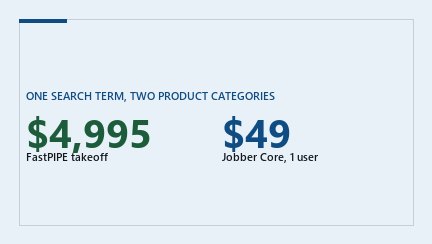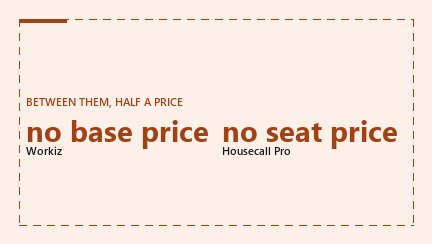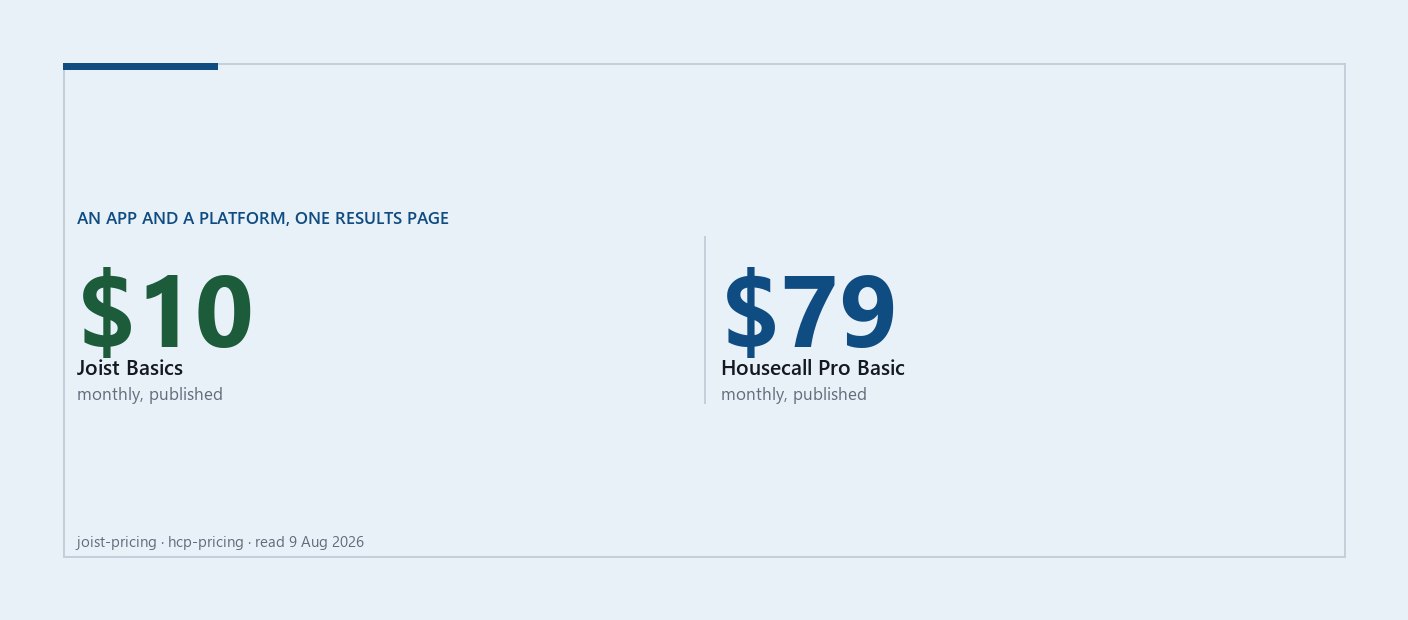
Two product categories share this results page and their published prices differ by eight times. The gap is not a discount. And for most shops the subscription is not the number that matters.
The short answer
If the invoice is the only thing you need software for, an invoicing app does it for around $10 a month. If the invoice is the last step of a job you also scheduled, dispatched and quoted, you are buying a field service platform, and those start at $49.
The eight-times gap between them is a category difference, not a discount to hunt for. An invoicing app has no dispatch board and no scheduling engine behind it. A platform is mostly those things, with invoicing at the end.
What the two categories publish
Every figure read from the vendor’s own page on the date in the sources.
| Product | Category | Published price | Users included |
|---|---|---|---|
| Joist Basics | Invoicing and estimating app | $10 a month, or $100 billed annually ($8.34 a month) | Not published |
| Joist Pro | Invoicing and estimating app | $17 a month, or $170 billed annually ($14.17 a month) | Not published |
| Joist Elite | Invoicing and estimating app | $32 a month, or $320 billed annually ($26.67 a month) | Not published |
| Jobber Core | Field service platform | $49 a month, no commitment | 1. Additional users $29 a month each |
| Housecall Pro Basic | Field service platform | $59 a month billed annually; $79 monthly | Not published |
| ServiceTitan | Field service platform | Not published | Not published |
Joist publishes a clean three-tier grid and does not publish how many users a tier includes. Housecall Pro publishes neither the seat count nor the additional-user rate. Jobber publishes both. A buyer comparing these on the monthly figure alone is comparing three different things.
Joist also publishes an AI receptionist add-on at $49 a month — which is, on its own, more than the Elite plan and as much as a Jobber Core seat. Add-ons are where the tidy grid stops being tidy, and they are worth pricing before signing rather than after.
What getting paid costs, on published rates
Both platforms that publish processing rates charge a percentage of the money you move. The rates below are published; the volume is an assumption, stated so you can substitute your own.
| Route | Published rate | On $40,000 across 400 invoices |
|---|---|---|
| Jobber, card | 2.9% + 30¢ per transaction | $1,160 + $120 = $1,280 |
| Jobber, bank transfer (ACH) | 1% | $400 |
| Housecall Pro, card | “as low as 2.59%” | Not calculable — see below |
| Housecall Pro, bank payments | “A 1% fee is applied to bank payments” | $400 |
The Housecall Pro card row carries no figure on purpose. “As low as” states a floor, not a rate, and the page does not publish what determines where a given shop lands. A number computed from a floor would be a best case presented as a forecast.
The difference between the two Jobber routes is $880 a month. That is $10,560 a year, against a $49 subscription. Moving a portion of your customers from card to bank transfer is worth more than any subscription decision on this page, and it costs nothing to try.
The full treatment of processing as a line item, including why it is frequently larger than the software itself, is in payment processing fees. If the search that brought you here was about producing the number rather than sending it, that is a different product category again — plumbing estimating software.
Which one you should buy
Three questions, in order.
- Does anyone need to see a schedule? If jobs are assigned by a phone call and everyone knows where they are going, an invoicing app is enough. If someone maintains a board, you need a platform.
- Does the price exist before you arrive? A shop working from a flat-rate book wants quoting at the door, which is platform territory. A shop that invoices what it did afterwards does not.
- How many people invoice? This is where the unpublished seat counts bite. Jobber prices additional users openly at $29 a month; Joist and Housecall Pro do not publish it. For a two-person office the difference can invert the ranking.
The invoicing workflow itself — what happens between finishing a job and the money arriving — is in invoicing and getting paid. The plumbing-specific requirements a generic platform handles badly are in plumbing contractor workflow requirements.
What the results page looked like
Read on 9 August 2026, the US results page for this term returned six results and all six were companies selling invoicing or field service software. No independent publisher, no directory, nothing.
That is the most complete vendor coverage of any commercial query in this cohort. It also means the two-category distinction at the top of this page — apps against platforms — is one no result on that page has an interest in drawing, because each of them is on one side of it.
What this page cannot tell you
- What Joist or Housecall Pro cost for more than one user. Neither publishes the seat count included or the additional-user rate.
- What Housecall Pro’s card processing will cost you. “As low as 2.59%” is a floor and the page does not publish what moves it.
- What ServiceTitan costs. Not published.
- Whether the processing saving above holds for your customers. The rates are published; the $40,000 and the 400 invoices are an assumption, and your own numbers should replace them.
Sources
- Joist — primary vendor pricing page, read
- Jobber — primary vendor pricing page, read
- Housecall Pro — primary vendor pricing page, read
- ServiceTitan — quote gated confirmed, read
- Google US, read first-hand — observed serp, read
Vendor pricing changes without notice. Every figure above carries the date it was read. If a vendor’s current page disagrees with this one, the vendor’s page is right and this one is stale — and that is a bug worth reporting.