At realistic invoice volumes the card processing fee inside your field service platform costs several times the subscription. It is published, and almost nobody compares it.
The published rates
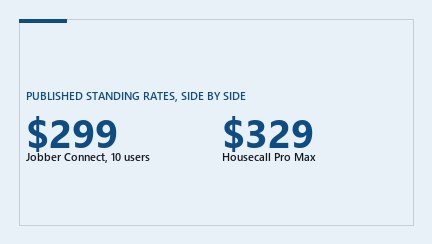
Jobber: 2.9% plus 30 cents for credit cards, 1% for ACH bank payments, 2.7% plus 30 cents for Tap to Pay.
Housecall Pro: card processing “as low as 2.59%”, and “a 1% fee is applied to bank payments”.
Note the wording difference. “As low as” is a floor, not a rate — the rate you actually get depends on card type and qualification, and the page does not publish the range above the floor. Jobber’s figure is stated flat. Neither is dishonest; they are different disclosures and they compare differently.
The arithmetic that reframes the decision
Take a 10-technician service shop invoicing USD 160,000 a month, with 65% collected by card and the rest by cheque or bank transfer.
Card volume is USD 104,000. At 2.9% that is USD 3,016 a month. At 2.59% it is USD 2,694. The spread between those two published rates is USD 322 a month — USD 11,592 over three years.
The subscription for the same shop, on published Jobber pricing with 13 users on a mid tier, is a few hundred dollars a month. The processing spread alone is comparable to the entire subscription.
This is why “which is cheaper” is not answerable from tier prices, and why the calculator asks for your card volume before it returns anything.
The ACH lever
Both vendors publish 1% for bank payments. Moving a single USD 12,000 changeout from card to ACH saves roughly USD 228 at a 2.9% card rate. Moving 20% of a USD 160,000 monthly volume saves around USD 608 a month.
Whether your customers will pay by ACH is a real question — many residential customers will not, and commercial ones often prefer it. But it is a lever worth pricing, and it is entirely absent from the comparison content that ranks for these searches.
What we cannot tell you
We have not processed a payment through either platform. Effective rates depend on card mix, interchange and how the vendor qualifies transactions, and the real number on your statement may differ from the published rate.
What we can do is put the published rates side by side with the date we read them, and show you the arithmetic. Your own last three merchant statements will tell you more than any comparison page, including this one.
Sources
- Jobber — primary vendor pricing page, read
- Housecall Pro — primary vendor pricing page, read
Vendor pricing changes without notice. Every figure above carries the date it was read. If a vendor’s current page disagrees with this one, the vendor’s page is right and this one is stale — and that is a bug worth reporting.